TM1637 driven LED matrix
16 May 2026While the Titan Microelectronics
TM1637 controller chip is intended for driving numeric LED displays there is no reason why the six anode connections and eight cathode connections could not be used to drive alternative displays, and to show this here it is used with a Toyo LED D15881-M-UR3-0-W 8x8 LED matrix display.
This was a rather impulsive purchase from Amazon of the last display in stock since it was also going for a reasonable price and free delivery, although it turned out unexpectedly “interesting” in needings its own mini-investigation.
The original intention was to use this LED display as part of a circuit in which the controller chip also read button input, which was dropped in favour of spinning out this stand-alone article.
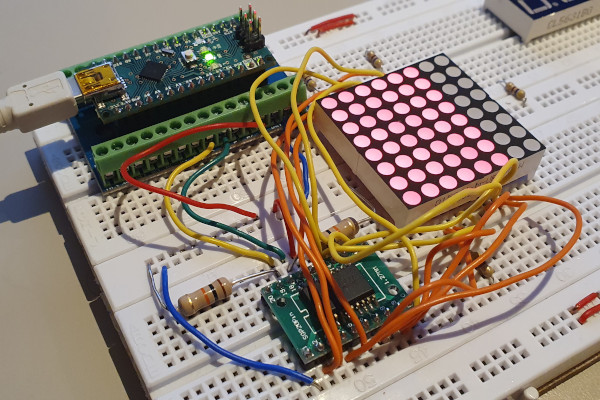
Rather than using the off-the-shelf Arduino library testing was done using a work-in-progress of an entirely new firmware, with one of the motives for starting from scratch being the stepping-stone of writing firmware for a microcontroller rather than Arduino. However firmware issues are out of scope here and will be detailed in a future article.
LED matrix pin-out
What was purported to be the data-sheet for theD15881-M-UR3-0-W 8x8 LED matrix chip gave what was not even close to being a correct pin-out so a bit of investigation was done to find the correct one and this is given below, where Cx refers to an anode column and Rx refers to a cathode row.
I have not checked to see whether this pin-out allows the display chip to be placed upside-down but at a glance suspect this is not the case.
Indications are that the part is one that has been discontinued although that does not mean it is no longer being made.
When doing my LED matrix tile respin I noted how what seemed to be basically identical parts would come and go under different manufacturers and parts numbers, so clearly this is all white-label vendoring.
There is extreme variations in pricing for what may well be from the same factory.
| C8 | C7 | R2 | C1 | R4 | C6 | C4 | R8 |
| 16 | 15 | 14 | 13 | 12 | 11 | 10 | 9 |
| 1 | 2 | 3 | 4 | 5 | 6 | 7 | 8 |
| R5 | R7 | C2 | C3 | R8 | C5 | R6 | R3 |
Other chipsets within family
Whereas I have theTM1620 and
TM1668 on order for future experimentation and the latter of which ought to be capable of driving all dots on an 8x8 matrix, there is no apparent advantage in these chips in building an alternative to my microcontroller driven LED matrix tiles.
Looking over data-sheets that are mostly in Chinese some of the chips compensate by having an enable pin that acts as a chip select, but fundamentally having no addressing within the serial protocol which is clearly based on I2C is a serious handicap.
If I was able to obtain the chips for the dozen cents or so each that I have no doubt they go for within Shenzhen and be able to get other package sizes it would be a different equation.